Journalist Harassment vs Newsgathering: Stalking Laws
By The National Press Association editorial team · Last reviewed:
Journalists get no special immunity from general laws, so stalking and harassment statutes can apply to reporters. These laws turn on intent, repeated conduct, and fear or substantial emotional distress. Some states build in protections for protected activity or public-concern speech. Check your state's law.
Key takeaways
- Reporters have no special immunity from generally applicable laws, including stalking and harassment laws.
- Most of these laws look at a pattern of repeated conduct aimed at one person, plus intent, fear, or distress.
- California and Texas write protections for protected activity or public-concern speech into parts of their laws.
- Counterman v. Colorado requires proof that a speaker had some subjective understanding that statements were threatening.
- Record the news purpose of every contact, and call a media lawyer if you get legal papers.
Reporting often means contacting people who do not want to hear from you [1]. Stalking and harassment laws look at repeated conduct aimed at one person [2]. Sometimes those laws can catch routine reporting [1].
This guide covers what those laws say, what courts have said about reporters, and how to document a legitimate purpose. It is general information, not legal advice.
Why can routine reporting look like harassment?
According to the Reporters Committee for Freedom of the Press (RCFP), journalists are expected to interview as wide a range of people as possible [1]. They are also expected to make determined efforts to get comment from the subject of a story [1].
The RCFP's Supreme Court brief gives two examples of conventional steps that can look intrusive. One is contacting a public servant's friends and family to build a full picture of their life [1]. The other is waiting outside an office building to speak to an executive about the conduct of the corporation they lead [1].
The same brief argues that statutes meant to punish threatening or harassing conduct can be, and have been, misused to target members of the press doing routine newsgathering on matters of public concern [1]. That is an advocacy argument. It still shows why you need to know the rules before you make the fifth call.
What do stalking and harassment laws actually require?
The federal, California, and Texas laws below use different wording. Read them as examples, not as a map of your state.
Federal law
The federal stalking statute, 18 U.S.C. § 2261A, centers on state of mind. It covers a person acting with intent to kill, injure, harass, intimidate, or place another person under surveillance with that same intent [3].
It also reaches online and phone-based conduct. The statute covers using the mail, an interactive computer service, or another facility of interstate or foreign commerce to engage in a course of conduct [3].
Federal law defines a "course of conduct" as a pattern of conduct made up of two or more acts that show a continuity of purpose [2]. The Justice Department's Office on Violence Against Women describes stalking as a course of conduct aimed at a specific person. It says the conduct would cause a reasonable person to fear for safety or suffer substantial emotional distress [4].
California
California's law applies to a person who willfully, maliciously, and repeatedly follows, or willfully and maliciously harasses, another person. That person must also make a credible threat meant to put the target in reasonable fear for their safety [5].
The statute defines "harass" as a knowing and willful course of conduct aimed at a specific person. The conduct must seriously alarm, annoy, torment, or terrorize the person and serve no legitimate purpose [5]. Those last words make your reason for each contact worth recording [5].
Texas
Texas stalking falls under Penal Code § 42.072. It requires knowing conduct on more than one occasion, as part of the same scheme or course of conduct aimed at a specific person [6].
The stakes are high. Texas stalking is a third-degree felony. It becomes a second-degree felony if the person has a prior conviction under that section or the similar offenses the statute lists [6].
Texas has a separate harassment statute, § 42.07. It covers publishing repeated electronic communications on a website or social media platform in a manner reasonably likely to cause emotional distress, abuse, or torment [6].
Do journalists get special protection from these laws?
No. In Cohen v. Cowles Media, the Supreme Court said generally applicable laws do not offend the First Amendment simply because enforcing them against the press has incidental effects on newsgathering and reporting [7].
The Court, quoting an earlier decision, said a newspaper publisher has no special immunity from general laws [7]. It added that enforcing general laws against the press is not subject to stricter scrutiny than enforcing them against other people or organizations [7].
The Court also said the press may not with impunity break and enter an office or dwelling to gather news [7]. Treat stalking and harassment laws as applying to you like anyone else, whether or not you work for a newsroom [7].
A press credential does not change that [7]. If you want a way to document who you are and what you report, read our guide to press credentials for independent reporters.
What did Counterman v. Colorado decide?
Counterman is a stalking-statute case about threatening messages. The Colorado statute at issue is titled a "stalking" statute, according to the Court's opinion [8]. The defendant sent hundreds of Facebook messages from 2014 to 2016 to a local singer and musician [8].
Document · Supreme Court of the United States
Counterman v. Colorado, No. 22-138 (U.S. June 27, 2023) slip opinion
Document from Supreme Court of the United States. Open at supremecourt.gov. Content from supremecourt.gov loads only if you click.
The Supreme Court held in 2023 that, in true-threats cases, the State must prove the defendant had some subjective understanding of the statements' threatening nature [8]. The First Amendment requires no more demanding a showing than recklessness [8].
The Court said a subjective standard is still required so that prosecutions do not chill too much protected, non-threatening expression [8]. The RCFP filed an amicus brief in the case. It argued that harassment and threat statutes can be misused against routine newsgathering [1].
The holding covers true threats [8]. Other conduct, and other state laws, may work differently, so check your state's law.
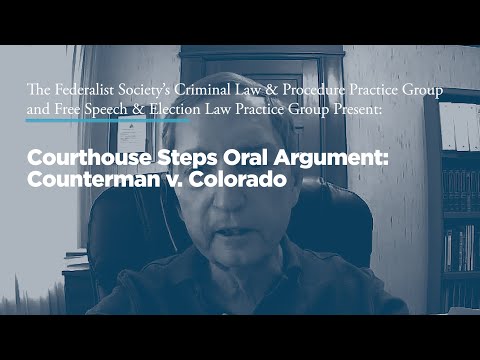
Video from The Federalist Society (YouTube). Open at youtube.com. Content from youtube.com loads only if you click.
Do any statutes protect newsgathering?
Some do, in part. California's stalking statute says constitutionally protected activity is not included within the meaning of "course of conduct." [5]
Texas's online harassment provision excepts communications made in connection with a matter of public concern [6]. That carve-out sits in the harassment statute's website and social media provision, not across every Texas offense [6].
These written carve-outs are useful. Check your state's law to see whether it has similar language.
Where has reporting run into these laws?
Two examples from the Reporters Committee show the risk.
The first is a restraining order. The RCFP brief cites a reported case in which a cosmetic surgeon used false claims of threatened violence to obtain a restraining order against two Los Angeles Times reporters. The reporters were investigating whether he was practicing medicine without a license [1].
The second is Michigan. In a 2000 report, the RCFP said a federal judge found Michigan's anti-stalking law overbroad [9]. The judge noted the statute would allow a reporter to be prosecuted for repeatedly contacting a reluctant news source [9].
That was one judge's ruling, and the state attorney general appealed [9]. Do not read it as settled law.
What about intrusion claims and anti-paparazzi laws?
Stalking statutes are not the only risk. The RCFP's First Amendment Handbook says intrusion claims against the media often center on some aspect of the newsgathering process [10].
The Handbook also warns that anti-paparazzi laws may create statutory liability, sometimes both civil and criminal, on top of liability for invasion of privacy [10]. It says an actionable intrusion claim may arise whether or not a story is published or aired [10]. Dropping the story does not end your exposure.
How can you keep contact reasonable and documented?
These steps rest on the sources above. They reduce risk. They do not remove it.
- Read your state's statutes. California and Texas word their laws differently, so yours may differ from both [5]. [6]
- Write down your reason for each contact. California asks whether the conduct serves a legitimate purpose, so note the story, the date, and why you reached out [5].
- Count your repeats. Federal law looks for two or more acts, and Texas looks for conduct on more than one occasion [2]. [6] Before each new attempt, ask what you still need to learn.
- Ask for comment. Do not demand it. The RCFP describes determined efforts to obtain comment as an expected part of reporting [1].
- Keep every message free of anything that could read as a threat. The Counterman Court looked at the speaker's own understanding of the statements' threatening nature [8].
- Stay out of private offices and homes unless you are invited. The Supreme Court has said the press may not break and enter to gather news [7].
- Record why you were somewhere. The RCFP lists waiting outside an office building to speak to an executive as a conventional step, and a note on your purpose supports that [1].
If you work without a newsroom, you can join the National Press Association and decide for yourself whether it helps your work. Membership does not change the legal picture, because journalists have no special immunity from general laws [7].
What are the limits, and when should you call a media lawyer?
This guide covers a handful of laws. Yours may differ, and courts may read the same words in different ways. Check your state's law.
The penalties can be serious. Texas treats stalking as a felony [6]. A restraining order was used against reporters in the Los Angeles Times example [1].
Call a media lawyer before you contact someone again if any of these happens:
- You receive a demand to stop contacting a person.
- You are served with restraining order papers.
- Police contact you about your reporting.
- You plan to keep pursuing someone who has refused to talk.
Do not wait to see how a court reads your conduct. The Reporters Committee publishes legal resources for journalists, including its First Amendment Handbook [10]. Use it for background, then get advice about your own facts.
If you need legal help, the Reporters Committee for Freedom of the Press runs a Legal Hotline for journalists and media lawyers [11].
Frequently asked questions
Can a journalist be charged with stalking for repeatedly contacting a source?
Possibly. Journalists have no special immunity from general laws, and stalking statutes look at repeated conduct aimed at one person. In 2000 a federal judge noted that Michigan's law would allow a reporter to be prosecuted for repeated contact with a reluctant source, though the state appealed. Check your state's law and ask a media lawyer.
Do stalking laws have an exception for protected activity?
Some do. California's stalking statute says constitutionally protected activity is not included within 'course of conduct.' Texas's online harassment provision excepts communications made in connection with a matter of public concern. Other states may differ, so check your state's law before you rely on an exception.
What did the Supreme Court decide in Counterman v. Colorado?
The Court held that in true-threats cases the State must prove the defendant had some subjective understanding of the statements' threatening nature. The First Amendment requires no more demanding a showing than recklessness. The case involved hundreds of Facebook messages sent to a local singer and musician under a Colorado stalking statute.
Does the First Amendment exempt journalists from laws like trespass or harassment statutes?
No. In Cohen v. Cowles Media, the Supreme Court said generally applicable laws do not offend the First Amendment simply because enforcing them has incidental effects on newsgathering. It said a publisher has no special immunity from general laws, and the press may not with impunity break and enter to gather news.
What is a 'course of conduct' in a stalking law?
It depends on the law. Federal law defines it as a pattern of two or more acts showing a continuity of purpose. Texas requires conduct on more than one occasion under the same scheme or course of conduct. California requires a knowing and willful course of conduct aimed at a specific person.
Answers restate the sourced facts on this page.
NPA membership is separate from any credential an agency issues
The National Press Association credential is a private association credential. It is not government-issued, it does not give you legal rights, and it does not guarantee access to any event, venue, or agency. It can serve as identity verification and supporting documentation alongside your published work. It is free to apply.
Sources
- Brief of Amicus Curiae the Reporters Committee for Freedom of the Press in Support of Petitioner, Counterman v. Colorado, No. 22-138, Reporters Committee for Freedom of the Press (filed in the U.S. Supreme Court) (secondary source; retrieved October 24, 2026)
- 18 U.S.C. § 2266 - Definitions (Domestic Violence and Stalking chapter), Legal Information Institute, Cornell Law School (U.S. Code text) (primary source; retrieved October 24, 2026)
- 18 U.S.C. § 2261A - Stalking, U.S. Code (Office of the Law Revision Counsel, uscode.house.gov) (primary source; retrieved October 24, 2026)
- Stalking (Office on Violence Against Women), U.S. Department of Justice, Office on Violence Against Women (primary source; retrieved October 24, 2026)
- California Penal Code § 646.9 (Stalking), California Legislative Information (leginfo.legislature.ca.gov) (primary source; retrieved October 24, 2026)
- Texas Penal Code Chapter 42 (§ 42.07 Harassment; § 42.072 Stalking), Texas Constitution and Statutes (statutes.capitol.texas.gov) (primary source; retrieved October 24, 2026)
- Cohen v. Cowles Media Co., 501 U.S. 663 (1991), Supreme Court of the United States (via Cornell LII) (primary source; retrieved October 24, 2026)
- Counterman v. Colorado, 600 U.S. 66 (2023) (slip opinion, No. 22-138), Supreme Court of the United States (primary source; retrieved October 24, 2026)
- Judge finds state anti-stalking law unconstitutional (Jul. 25, 2000), Reporters Committee for Freedom of the Press (secondary source; retrieved October 24, 2026)
- First Amendment Handbook, Reporters Committee for Freedom of the Press (secondary source; retrieved October 24, 2026)
- Reporters Committee Legal Hotline, Reporters Committee for Freedom of the Press (primary source; retrieved October 24, 2026)
Primary sources are statutes (federal, California, Texas), the Justice Department's stalking definition, and two Supreme Court opinions. No court opinion fetched squarely holds that a reporter's persistent but good-faith newsgathering is immune from stalking statutes; the pack draws on statutory text, general First Amendment doctrine (Cohen), Counterman (a non-journalist stalking case), and RCFP commentary. State law varies; only California and Texas statutes were read.
Last reviewed: .