How Journalists Use the Federal Register, Regulations.gov
By The National Press Association editorial team · Last reviewed:
Use the Federal Register for the official notice of rules, proposed rules and notices. Use Regulations.gov to find the docket and public comments for a rule. Search both, subscribe to alerts by agency or search, and confirm the official version before you publish. Some agencies' dockets and some comments will not appear.
Key takeaways
- The Federal Register is the official notice. Regulations.gov holds the docket and public comments for participating agencies.
- Public Inspection shows documents a day before they are scheduled to publish, but agencies can withdraw them.
- You can set alerts by agency, by saved search, or for each day's full filings.
- Agency websites, withheld comments and non-participating agencies all limit what you can see.
- Cite the official Federal Register version, not an early copy.
What do the Federal Register and Regulations.gov each do?
The two sites do different jobs. They work together, but Regulations.gov may lack a docket for some agencies [1]. [2]
The Federal Register is the official daily publication for rules, proposed rules, notices, executive orders and other presidential documents [2]. Under the Administrative Procedure Act, general notice of a proposed rule is to be published there [3].
Regulations.gov works like a filing cabinet. A docket is an electronic folder that holds documents related to rulemaking or non-rulemaking actions [1]. Most agencies mainly ask for public comments on that site [4].
In short, the Federal Register is the notice. The docket is the paper trail behind it [2]. [1]
How does a rule move from notice to final rule?
The Administrative Procedure Act sets the basic path. First, the agency publishes notice of a proposed rule in the Federal Register [3]. Then it must give interested people a chance to take part by sending written data, views or arguments [3].
That is the comment stage. The Congressional Research Service says agencies typically give at least 30 days for public comment [4].
Next comes the final rule. A substantive rule generally must be published at least 30 days before its effective date, with listed exceptions [3]. Do not assume a rule gets the full 30 days. The Congressional Research Service also notes exceptions [4].
Shortcuts exist. An agency may skip notice and public procedure if it finds good cause and says so, with a brief statement of reasons, in the rules it issues [3]. If you see a rule with no comment period, check whether the agency stated a good-cause finding in the rules it issued [3].
Some rules get an additional review. Under E.O. 12866, agencies send their "significant" proposed and final rules to OIRA before publication [4].
How do you read a Federal Register document?
Start with the document type. Rules, proposed rules and notices all appear in the Federal Register [2]. Check which one you have before you write "new rule" in a draft.
Then read the dates with care. For many filed documents, the Office of the Federal Register calculates and inserts the effective and comment dates only after the document goes on file [5]. A document you see early may not show them yet.
Know which version counts. Only an official format of a Federal Register document gives legal notice to the public and judicial notice to the courts under 44 U.S.C. 1507 [5]. GovInfo says its online edition is the official legal equivalent of the paper and microfiche editions [2].
The video below is a recorded tutorial on the Federal Register. Watch it for a walkthrough, then compare what you see with the live site.
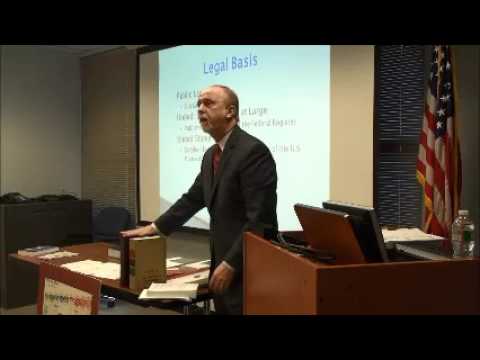
Video from US National Archives. Open at youtube.com. Content from youtube.com loads only if you click.
What is Public Inspection, and how do you use it?
Public Inspection is a preview. The page on FederalRegister.gov shows documents scheduled to appear in the next day's Federal Register issue [5].
A new set of documents goes up every morning, on or about 8:45 a.m. Eastern Time [5]. If your beat is a single agency, that is a good time to check.
Treat what you find as tentative. Agencies may withdraw documents before they are published [5]. Write "scheduled to be published," not "published," until the official issue appears.
Those early documents may also lack final dates. The Office of the Federal Register inserts many effective and comment dates after filing [5].
Step by step: how do you find a rule, its docket and its comments?
Use this sequence when a rule lands on your beat.
- Search FederalRegister.gov for your topic. You can also open the page for the agency you cover [6].
- Open the document. Note the agency, the document type and any effective or comment dates. Some dates may be added after filing [5].
- If it is a proposed rule, find out whether the comment period is still open. Agencies typically allow at least 30 days [4].
- Search Regulations.gov for the same rule to find its docket. A docket collects the related documents in one place [1].
- Check that the agency's dockets appear on Regulations.gov at all. The site does not post dockets or public comments for non-participating agencies [1].
- Open the comments. Remember that you may not see all of them [1].
- Save the official Federal Register version of the document for your notes [5].
Regulations.gov says its data dates back to 2002 [1]. Plan to look elsewhere for anything older.
The video below shows search tools on Regulations.gov. It may be older than the current site, so menus may look different from what you see today.
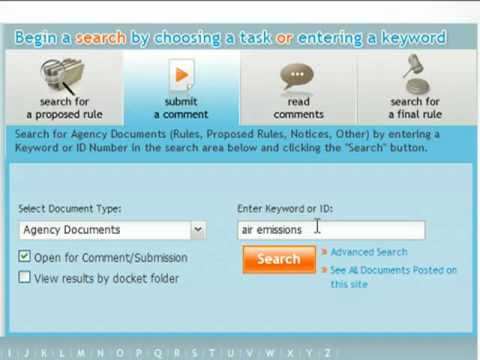
Video from regulationsgov (official Regulations.gov YouTube channel). Open at youtube.com. Content from youtube.com loads only if you click.
How do you set up alerts for your beat?
Alerts save you from checking every day. FederalRegister.gov lets you subscribe to a particular agency's documents from that agency's page [6].
You can also build a custom alert. Subscribing to a specific search result creates email and RSS notifications [6]. Save a search for a company name, a chemical, a program or a place on your beat.
The same service covers Public Inspection. It can notify you of filings by agency, by saved search terms, or for the full set of documents filed each day [6].
Start with one agency and one or two saved searches, then adjust [6].
The video below walks through tracking regulatory changes on FederalRegister.gov. Use it as a second look at the same tools.
How do you track a rule over time?
Three tools help you follow a rule beyond a single notice.
First, the Regulation Identifier Number, or RIN. It is a unique 8-digit code assigned by the Regulatory Information Service Center. It lets you search for a regulation and track it through its lifecycle [1]. Copy the RIN into your notes.
Second, the Regulatory Agenda, also called the Unified Agenda. Each federal agency publishes one twice a year, in the Spring and Fall [1]. GovInfo describes it as uniform reporting on the actions agencies plan to issue in the near and long term [2]. Read it for hints about what an agency may do next.
Third, OIRA review. Agencies send significant proposed and final rules to OIRA before publication [4]. An older tip sheet from the Society of Environmental Journalists said Reginfo.gov has a search showing which proposed rules are at OMB for review [7]. Check the current site to see how that search works today.
These tools show you the paper trail. The reporting comes after [7].
What are the limits of these tools?
Know what you cannot see before you build a story on it.
Agency websites may run ahead. You may find new rules on an agency's site before Federal Register publication. That version is not official, and the effective date generally depends on Federal Register publication [2].
Some agencies are missing. Regulations.gov does not post the dockets or public comments of non-participating agencies [1]. For those, you will need to look beyond Regulations.gov, starting with the agency itself.
Comments are incomplete. Not every comment is public [1]. Agencies may redact or withhold some, including those with private or proprietary information, inappropriate language, or duplicate or near-duplicate mass-mail campaign comments [1]. Do not report a comment count as the total number of people who wrote in.
Early documents can change. Agencies may withdraw documents shown on Public Inspection [5].
A missing docket may mean the agency does not post on Regulations.gov [1]. Separately, agencies may skip notice and public procedure when they find good cause and state it in the rules they issue [3].
When a story turns on what a rule means in law, ask a lawyer. These tools show you what an agency published. They do not tell you how a court would read it.
You can join the National Press Association as a professional affiliation. It does not give you legal rights or special access.
What should you check before you publish?
Run this list on every story built on an agency action.
- Did you read the official Federal Register version, not only an agency web page [2]?
- If you used Public Inspection, did you check that the document was actually published [5]?
- Did you confirm the effective date from the published document [5]?
- Did you check whether the agency's dockets appear on Regulations.gov [1]?
- Did you say that some comments may be withheld or redacted [1]?
- Did you save the RIN and docket number for your notes [1]?
Keep copies of what you relied on. If you need a way to document your work as an independent reporter, see how a press credential can document your work. A credential does not give you legal protection.
Frequently asked questions
What is the difference between the Federal Register and Regulations.gov?
The Federal Register is the official daily publication of rules, proposed rules, notices and presidential documents. Regulations.gov holds dockets, which are electronic folders of related documents, and is where most agencies collect public comments. Non-participating agencies' dockets and comments are not posted there.
Can I read a rule before it is officially published in the Federal Register?
Sometimes. Public Inspection previews documents scheduled for the next day's issue, and agencies may post rules on their own sites early. An agency-site version is not the official one, and Public Inspection documents are only tentatively scheduled. Agencies can withdraw them before publication.
Is FederalRegister.gov an official legal source I can cite?
Only an official format of a Federal Register document gives legal notice under 44 U.S.C. 1507. GovInfo says its online edition is the official legal equivalent of the paper edition. Check which format you are citing before you publish.
How do I get alerts when an agency publishes something on my beat?
FederalRegister.gov lets you subscribe to an agency from its page. You can also subscribe to a specific search result for email or RSS alerts. The service also covers Public Inspection filings by agency, saved search or the full daily set.
Why can't I see every public comment on a proposed rule?
Not every comment is made public. Agencies may redact or withhold some, including those with private or proprietary information, inappropriate language, or duplicate mass-mail comments. Dockets, public comments and supporting materials of non-participating agencies are not posted on Regulations.gov.
What is a docket, and what is a RIN?
A docket is an electronic folder on Regulations.gov that holds documents related to a rulemaking or non-rulemaking action. A Regulation Identifier Number, or RIN, is a unique 8-digit code assigned to a regulation that lets you search for it and track it over time.
Answers restate the sourced facts on this page.
NPA membership is separate from any credential an agency issues
The National Press Association credential is a private association credential. It is not government-issued, it does not give you legal rights, and it does not guarantee access to any event, venue, or agency. It can serve as identity verification and supporting documentation alongside your published work. It is free to apply.
Sources
- Regulations.gov Frequently Asked Questions, Regulations.gov (eRulemaking Program) (primary source; retrieved October 24, 2026)
- Federal Register (GovInfo help page), U.S. Government Publishing Office (GovInfo) (primary source; retrieved October 24, 2026)
- 5 U.S. Code 553 - Rule making, Legal Information Institute, Cornell Law School (statute text) (primary source; retrieved October 24, 2026)
- An Overview of Federal Regulations and the Rulemaking Process (CRS In Focus IF10003), Congressional Research Service (Library of Congress) (primary source; retrieved October 24, 2026)
- Understanding Public Inspection, Office of the Federal Register (FederalRegister.gov Reader Aids) (primary source; retrieved October 24, 2026)
- Subscription Options and Managing Your Subscriptions, Office of the Federal Register (FederalRegister.gov Reader Aids) (primary source; retrieved October 24, 2026)
- TOOLBOX: Reginfo.gov Offers Beat Reporters a Powerful Mischief Detector, Society of Environmental Journalists (WatchDog TipSheet, Aug. 13, 2008) (secondary source; retrieved October 24, 2026)
Six of seven sources are primary (federal agency pages and statute text via Cornell LII). The one secondary source (SEJ tip sheet) is from 2008 and is used only for the Reginfo.gov point. No journalism-organization guide dedicated to the Federal Register itself was found.
Last reviewed: .